AI & Tech-Driven Wedding Planning: How Indian Couples Are Planning Smarter in 2026
Indian weddings now run on a mix of spreadsheets, WhatsApp groups and, more and more, AI. Couples are using chatbots to shortlist venues, apps to track a shared budget in real time, and AI-built wedding websites to keep three hundred relatives updated without printing a single card twice.
None of this replaces a planner who actually knows your city, your vendors and your family's quirks. What it does is cut the hours you used to spend on hold with caterers and cross-checking guest counts on three different phones. This guide walks through what AI and wedding tech genuinely do well in 2026, where they still fall short, and how to combine both without losing the parts of your wedding that should stay personal.
Why Indian Couples Are Turning to Wedding Tech
India's wedding industry is valued at roughly ₹4.74 lakh crore, and a large share of the couples spending that money grew up online. They expect the same convenience from wedding planning that they get from food delivery or online shopping: real-time updates, transparent pricing, and the ability to compare options without a dozen phone calls.
The shift accelerated after the pandemic years, when hybrid ceremonies, live-streaming and digital invites went from a workaround to a habit. Add cheap data and near-universal smartphone use, and it makes sense that platforms with a large, verified vendor base and instant quotes, like Plan4Event's network of
Add cheap data and near-universal smartphone use, and it makes sense that couples now expect a large, verified vendor base and instant quotes. Plan4Event's network of 39,000+ wedding venues and 6,000+ decorators exists precisely because couples want that comparison shopping experience, backed by real reviews from real weddings, not just an algorithm's best guess
The AI and Tech Tools Actually Reshaping Wedding Planning
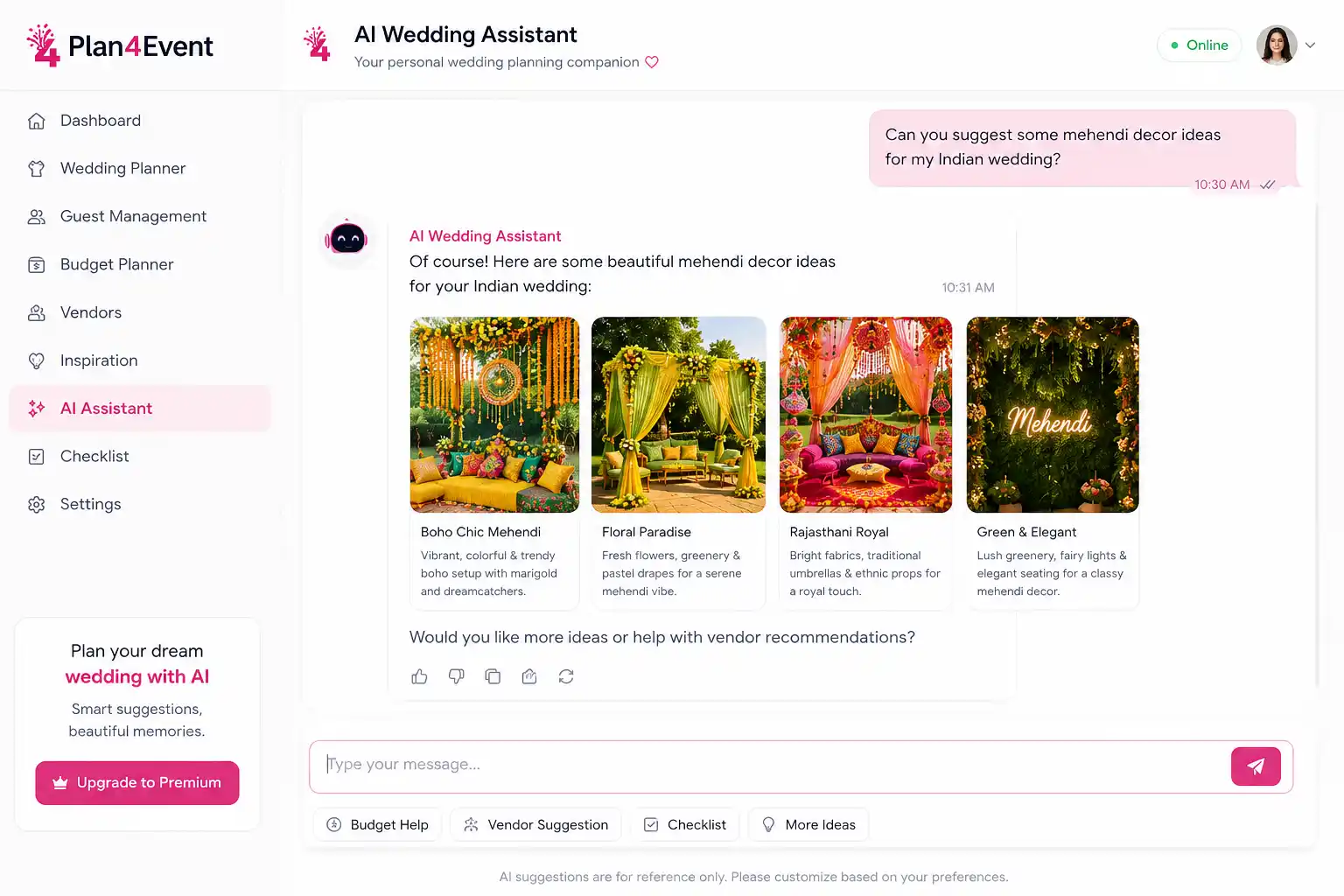
1. AI Wedding Assistants and Chatbots
Couples now type prompts like 'suggest a mehendi decor theme under ₹1 lakh' into a chatbot the way they'd once have opened Pinterest. Apps such as WedMeGood's Genie and Wedika, and independent tools like Wedd.ai, take a couple's budget and preferences and return a shortlist instead of an open-ended search. The Knot's internal research found that 54% of couples now use AI at least occasionally while planning, with roughly one in four using it regularly.
The catch is that a chatbot can suggest ideas, but it can't sit across the table and negotiate a caterer's per-plate rate or tell you which decorator actually delivers on the mood board they pitched. That's still a conversation for a verified wedding planner who has worked that vendor before.
2. Smart Guest List and RSVP Management
Indian weddings rarely have a clean yes/no RSVP. A guest might attend the sangeet and skip the mehendi, or confirm for two and show up with six. Manually tracking that across a Haldi, Mehendi, Sangeet and Reception in one spreadsheet is where most planning teams lose entire evenings.
AI-based guest tools now deduplicate contact lists across both families, tag guests by relationship and event, and update headcounts automatically the moment someone responds. That single change removes one of the most common sources of catering and seating errors on the actual wedding day.
3. AI-Powered Budget and Expense Tracking
Budget calculators built into modern planning apps categorise spending, flag when a category is running over, and adjust the remaining budget in real time as bookings are confirmed. This matters most for couples working within a fixed number, whether that's a lakh-heavy destination wedding or a budget wedding under ₹5 lakhs. Automated tracking replaces the shared Excel sheet that three family members have each edited differently.
4. Digital Invitations and AI-Built Wedding Websites
AI tools can now generate a complete wedding website, with the couple's story, a full event schedule using the correct Indian ceremony names, venue maps and an RSVP form, in under ten minutes. Pair that with a set of custom e-invitation designs sent directly over WhatsApp, and a couple can update one link instead of resending corrected PDFs to five hundred guests.
5. Virtual Venue Tours and AI Vendor Discovery
Video walkthroughs and 3D venue previews let a couple sitting in Mumbai shortlist banquet halls in Udaipur, Jaipur or Goa without booking a single flight. Filters by budget, capacity and décor style narrow thousands of listings down to a handful worth an actual site visit, whether that's for a destination wedding or a city-based pre-wedding shoot location.
Where AI Still Gets It Wrong
Most of the coverage around AI and weddings leans either fully hyped or fully dismissive. The honest middle ground: AI is genuinely strong at structured, repetitive tasks, and it is not a substitute for judgment, taste or relationships.
● Vendor negotiation: AI can research market rates, but it can't read a room or build the trust that gets a photographer to stay an extra hour for free.
● Family and seating politics: an algorithm can optimise a seating chart mathematically, but it has no idea two uncles haven't spoken in six years.
● Contracts: AI is not a lawyer. Vendor agreements, cancellation clauses and advance payment terms still need a human who understands Indian wedding contracts.
● Day-of crises: when the caterer is running thirty minutes late and the baraat has arrived early, that needs a calm coordinator on the ground, not a chatbot.
As Holly Gray, owner of Anything But Gray Events, put it in a recent interview with The Knot: “AI doesn’t have to build it.” AI can hand a couple a mood board or a first-draft timeline. Turning that into an actual wedding day still takes a planner who has run enough events to know what breaks and how to fix it fast.
AI Tools vs. a Traditional Planner vs. a Hybrid Model
The table below breaks down where each approach genuinely helps, without overselling any single option.
|
Task
|
Doing It Manually
|
A Pure AI App
|
Plan4Event (Tech + Verified Planners)
|
|
Venue shortlisting
|
Days of calls and site visits
|
Fast, but listings can be outdated
|
Verified, updated listings with real reviews
|
|
Guest RSVP tracking
|
Shared spreadsheet, manual updates
|
Automated, but needs manual data entry setup
|
Automated tracking plus a coordinator who resolves mismatches
|
|
Budget management
|
Family-run Excel sheet
|
Real-time category tracking
|
Real-time tracking with a planner who flags overspend early
|
|
Vendor negotiation
|
Direct, time-consuming haggling
|
Not possible
|
Handled by a planner who already knows market rates
|
|
Day-of coordination
|
Family members double as managers
|
Not applicable
|
On-ground coordinator plus a digital run-of-show
|
A Jaipur Wedding Built on Tech Plus a Human Planner
Take a fairly typical Jaipur wedding: 350 guests across a Haldi, Mehendi, Sangeet and Reception, planned by a couple living in Bengaluru. The couple used an AI budget tracker to set category limits before any vendor conversation started, and shortlisted three banquet halls in Jaipur through virtual tours before flying down for a single in-person visit.
From there, a local wedding planner took over the parts AI couldn't: negotiating the final banquet rate, coordinating four vendors across four events, and managing the seating chart conversation with both families. The couple's own comparison of wedding planner costs across Indian cities helped them budget for that planner's fee from the start instead of treating it as a last-minute add-on.
The result was fewer wasted site visits and a clearer budget from day one, with the actual judgment calls still made by people who understood the family and the city.
How to Use AI for Your Wedding Without the Risks
● Use AI for information-heavy tasks: guest lists, RSVP tracking, budget categories, first-draft timelines.
● Keep emotional and creative decisions, like vows, first dance songs and final vendor picks, in human hands.
● Never let AI draft or interpret a vendor contract; have a person review every cancellation and payment clause.
● Check what a wedding app does with your guest list data before uploading it. Look for a clear policy on not training AI models on your contacts.
● Treat AI-sourced venue capacity or pricing as a starting point, not a final number. Confirm directly with the venue or your planner before booking.
Frequently Asked Questions
Can AI plan my entire wedding?
No. AI handles structured, repetitive tasks well, such as guest tracking, budgeting and first-draft timelines, but vendor negotiation, family dynamics and day-of coordination still need an experienced human planner.
What is the best AI tool for wedding planning in India?
There isn't one single best tool. Guest-list apps like Wedd.ai, chatbot assistants like Wedika, and budget trackers each solve a different, narrow problem. Most Indian couples end up using two or three tools alongside a human planner rather than one all-in-one AI platform.
Is it safe to share my guest list with an AI wedding app?
It depends on the app's data policy. Check whether the platform trains AI models on your data, stores it encrypted, and avoids sharing contact details with third parties before uploading a full guest list.
Will AI replace wedding planners in India?
Unlikely in the near term. AI is strong at organising information, but Indian weddings involve multi-day logistics, family negotiation and vendor relationships built over years, which is exactly where an experienced planner adds value AI can't replicate.
How much does AI-assisted wedding planning cost compared to a traditional planner?
Most AI planning apps are free or low-cost for basic features like guest tracking and budgeting. A full-service human planner's fee varies by city and wedding scale, typically starting from around ₹40,000 and scaling with guest count and number of events.
The Bottom Line
Tech has genuinely made Indian wedding planning less chaotic, from RSVP tracking to virtual venue tours. But the parts of a wedding that people remember, the seating next to the right cousin, the caterer who adjusted the menu at the last minute, the decorator who understood the vision without three rounds of revisions, still come from people who know what they're doing. If you want both, get a free consultation with Plan4Event and combine the convenience of modern planning tools with a verified planner who knows your city