Complete Wedding Planning & Coordination: The Full Guide for Indian Couples
Planning an Indian wedding usually means running four or five functions in under a week, managing forty-plus vendors, and keeping two families happy at the same time. Complete wedding planning & coordination is the service built for exactly that: one team handles everything from the first venue visit to the last vendor exit, so you're not the one chasing the decorator on your own haldi morning.
This guide covers what the service actually includes, a realistic complete wedding planning checklist you can follow month by month, what it costs in India right now, and how to pick a team that won't disappear the week it matters most.
What "Complete Wedding Planning & Coordination" Actually Means
The phrase gets used loosely, so it's worth being precise. Complete wedding planning covers the entire journey: setting the budget, shortlisting and booking the venue, sourcing every vendor, designing the décor and theme, building the day-by-day schedule, and managing the guest list. Coordination is the execution layer on top of that plan someone physically present at every function, running the timeline, briefing vendors, and fixing whatever goes wrong before you even notice it went wrong.
A lot of couples book only one half. They plan everything themselves over months of WhatsApp groups and spreadsheets, then hire a coordinator just for the final week. Others hire a full-service team from day one and never touch a vendor call. Complete wedding planning & coordination is the version where both halves sit with the same team, so nothing gets lost in the handoff between "who planned this" and "who's running it today."
Complete Wedding Planning vs Partial Planning vs Day-Of Coordination
Not every couple needs the same level of involvement. Here's how the three common service tiers actually differ:
|
Service Type
|
When It Starts
|
What's Included
|
Best For
|
|
Complete Wedding Planning & Coordination
|
8–12 months before
|
Budgeting, venue, vendors, design, guest logistics, full on-ground execution
|
Couples who want one accountable team, destination weddings, working professionals
|
|
Partial Planning
|
3–5 months before
|
Vendor referrals, budgeting help, timeline building; couple still makes final calls
|
Couples who've started planning but need help finishing
|
|
Day-of Coordination
|
2–4 weeks before
|
Timeline execution, vendor confirmations, on-site management only
|
Couples who've already booked everything and just need someone to run the day
|
If your wedding has more than two functions, involves out-of-town guests, or is happening at a venue neither family has used before, complete planning and coordination together tends to save more stress than splitting the two.
What's Included in a Complete Wedding Package
A genuine complete wedding package should cover these areas, not just décor and photography:
- Budget mapping - a realistic allocation across venue, catering, décor, attire, and vendors, with a buffer for the 10–15% that always comes up late
- Venue shortlisting and booking - including backup indoor space if any function is outdoors
- Vendor sourcing - decorators, caterers, photographers, makeup artists, entertainers, and transport, all vetted and negotiated on your behalf
- Design direction - one visual theme carried consistently across haldi, mehendi, sangeet, the wedding, and the reception
- Guest and hospitality management - accommodation blocks, airport pickups, and RSVP tracking
- Function-by-function run sheets - a printed or shared timeline every vendor and family member can follow
- On-ground coordination - a team physically present at each function, not just the wedding day
- Crisis handling - a backup plan for vendor delays, weather, or last-minute changes
If a "complete package" you're being quoted skips guest hospitality or coordination and only covers decor and photography, it's really just a vendor bundle, not complete planning.
Complete Wedding Planning Checklist: Month by Month

This is the part most guides skip past. Here's a working timeline for a typical multi-function Indian wedding:
10–12 months out Lock the wedding date and muhurat, set the total budget with both families in writing, and start the venue shortlist. Popular venues on good dates in cities like Jaipur get booked out this far ahead.
8–9 months out Book the venue and pay the advance after reading the cancellation terms carefully. Hire your planning and coordination team now if you haven't already, since good teams also get booked out early during peak wedding season.
6–8 months out Book the photographer and caterer — the two vendors that can only take one wedding per date. Finalise the guest list draft; even a rough count of 200 versus 400 changes catering and venue quotes significantly.
4–6 months out Book decorators, entertainers, and the makeup team. Finalise outfits and start alterations early rather than in the last month, when tailors are booked solid.
3–4 months out Send invitations, block hotel rooms for outstation guests with a 10–15% cancellation buffer, and confirm the menu with a tasting session.
6–8 weeks out Freeze the guest list. This is the step most couples skip, and it's usually the one that causes chaos later, since every name added after this point ripples into seating, catering counts, and invites.
2–4 weeks out Walk the venue with your coordination team, confirm every vendor delivery schedule, and finalise the run sheet for each function.
Wedding week Coordination takes over fully. Setup supervision, vendor check-ins, guest flow, and a dedicated point person so no family member has to field vendor calls during the ceremony.
How Complete Wedding Planning & Coordination Works, Step by Step
- Discovery call. The team learns your vision, must-haves, budget range, and which traditions matter most to your families.
- Budget and vendor plan. You get a transparent cost breakdown before any vendor is approached, not after.
- Venue and vendor booking. The team negotiates and books on your behalf, with contracts you review before signing.
- Design and décor finalisation. Mood boards and sample setups so there are no surprises on the day.
- Logistics and hospitality. Guest travel, accommodation, and RSVP tracking get built into the master timeline.
- Pre-wedding walkthrough. A final site visit two to four weeks out to confirm every detail with vendors present.
- Execution. The coordination team runs each function on-site, function by function, with the couple and families free to actually attend their own wedding.
What to Look for When Hiring a Complete Wedding Planning Team
|
What to Check
|
Why It Matters
|
|
Local vendor network
|
A team with existing relationships in your wedding city gets faster responses and better rates than one starting cold
|
|
Real, full-event portfolios
|
Highlight reels hide problems; ask to see how a team handled a full multi-day wedding, not just three polished photos
|
|
Multi-venue experience
|
If your functions span different venues or cities, confirm the team has actually coordinated across locations before
|
|
Written contract and cancellation terms
|
Get the inclusions, exclusions, and refund policy in writing before paying any advance
|
|
A single point of contact
|
You want one person accountable for the whole event, not five vendors each blaming the others when something slips
|
A Real Coordination Scenario
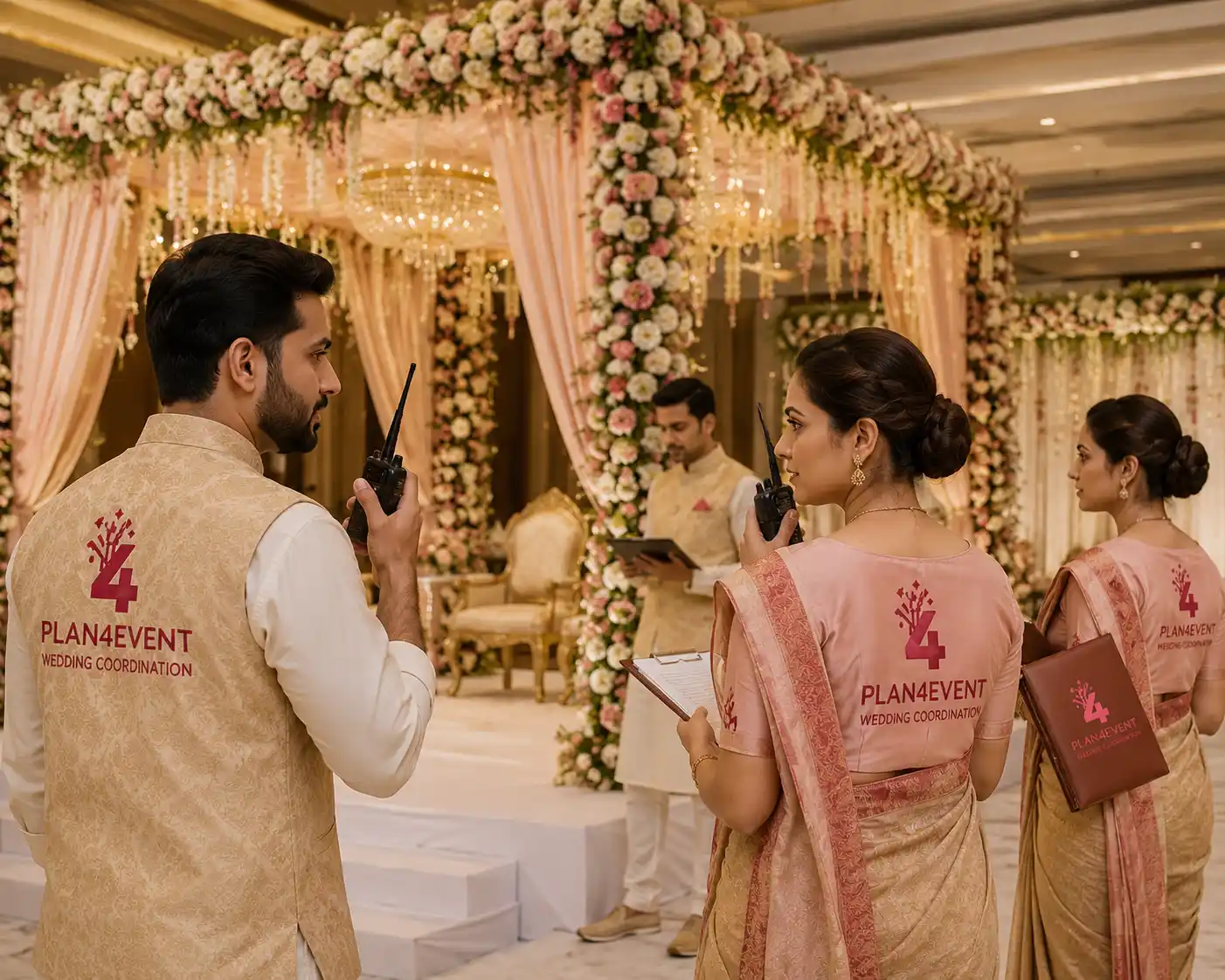
At a Jaipur banquet wedding, the decorator arrived nearly an hour late, the DJ's mixer failed during sound check, and the catering staff forgot serving spoons for two hundred guests. None of this reached the couple. The coordination team pulled a backup mixer from a partner vendor within twenty minutes, rerouted the decorator's remaining crew to finish the mandap first, and sent a runner to a nearby supplier for spoons before the buffet opened. The family only found out afterward, over breakfast the next morning.
That's the actual value of coordination: not that problems don't happen, because they always do, but that they get solved somewhere you never see.
Cost of Complete Wedding Planning & Coordination in India
Complete planning and coordination fees generally run as either a flat fee or a percentage of total wedding spend, and both vary a lot by city and scale. A mid-size wedding in Jaipur, Mumbai, or Gurgaon typically pays more for planning than a smaller city, simply because venue and vendor rates are higher across the board. For a full breakdown by city and wedding size, Plan4Event's wedding planner cost guide covers current fee ranges, what's usually included at each price point, and the hidden costs couples miss when comparing quotes.
If you're weighing a destination wedding against a hometown celebration, it's also worth comparing full destination wedding packages in India before locking your city, since travel and accommodation costs for guests can shift the total budget more than the venue itself does.
Complete Wedding Planning for Smaller and Intimate Weddings
Complete planning and coordination isn't only for five-hundred-guest weddings. Couples choosing a smaller, more personal celebration still benefit from having one team handle logistics, décor, and vendor coordination, often at a lower overall cost since fewer functions and guests mean a lighter vendor list to manage. If you're considering scaling down, this guide to small and intimate wedding ideas walks through venue options and budget ranges for guest counts under 100, and Plan4Event's small wedding venue listings are a good starting point for shortlisting spaces that suit a compact guest list.
Finding and Booking Your Wedding Team
Whether you go with a full-service planning company or want to book individual vendors and manage coordination yourself, Plan4Event lists verified venues, decorators, caterers, and photographers across Indian cities with real pricing and reviews attached, so you can compare options before committing an advance. For couples still deciding between a full-service planner and building their own vendor team, Plan4Event's guide on why couples use the platform breaks down how vendor verification and pricing transparency work.
Frequently Asked Questions
What does complete wedding planning and coordination include?
It covers the full planning process (budget, venue, vendors, design, and guest logistics) along with on-ground execution across every function, from haldi through the reception, handled by one accountable team.
What's the difference between a wedding planner and a wedding coordinator?
A wedding planner is involved from the start, typically six to twelve months out, and handles vendor booking, budgeting, and design from scratch. A coordinator steps in closer to the wedding, usually two to four weeks before, and focuses purely on executing a plan that's already in place.
How much does complete wedding planning cost in India?
Costs depend on city, guest count, and how many functions you're hosting. Planning fees are usually charged as either a flat rate or a percentage of total wedding spend; see the wedding planner cost guide for current city-wise ranges.
When should couples start wedding planning?
Most couples begin eight to twelve months out, which leaves enough time to book venues and in-demand vendors like photographers and caterers before their preferred dates fill up.
Can a complete wedding planning team handle multiple venues or a destination wedding?
Yes, provided the team has actual experience coordinating across locations. Ask for examples of past multi-venue or destination weddings before booking, since logistics change significantly once travel and multiple properties are involved.
What's the biggest mistake couples make during wedding planning?
Not freezing the guest list early enough. Every name added after invitations go out creates a chain reaction across seating, catering counts, and RSVPs, which is exactly the kind of last-minute chaos complete coordination is meant to prevent.